

Medical Device Manufacturing Process Development | ZIEN Medical Technologies
Developing a successful medical device prototype is a major achievement. It demonstrates that a concept can become a functional product capable of meeting an intended clinical need. However, a successful prototype does not necessarily mean a device is ready for commercial manufacturing.
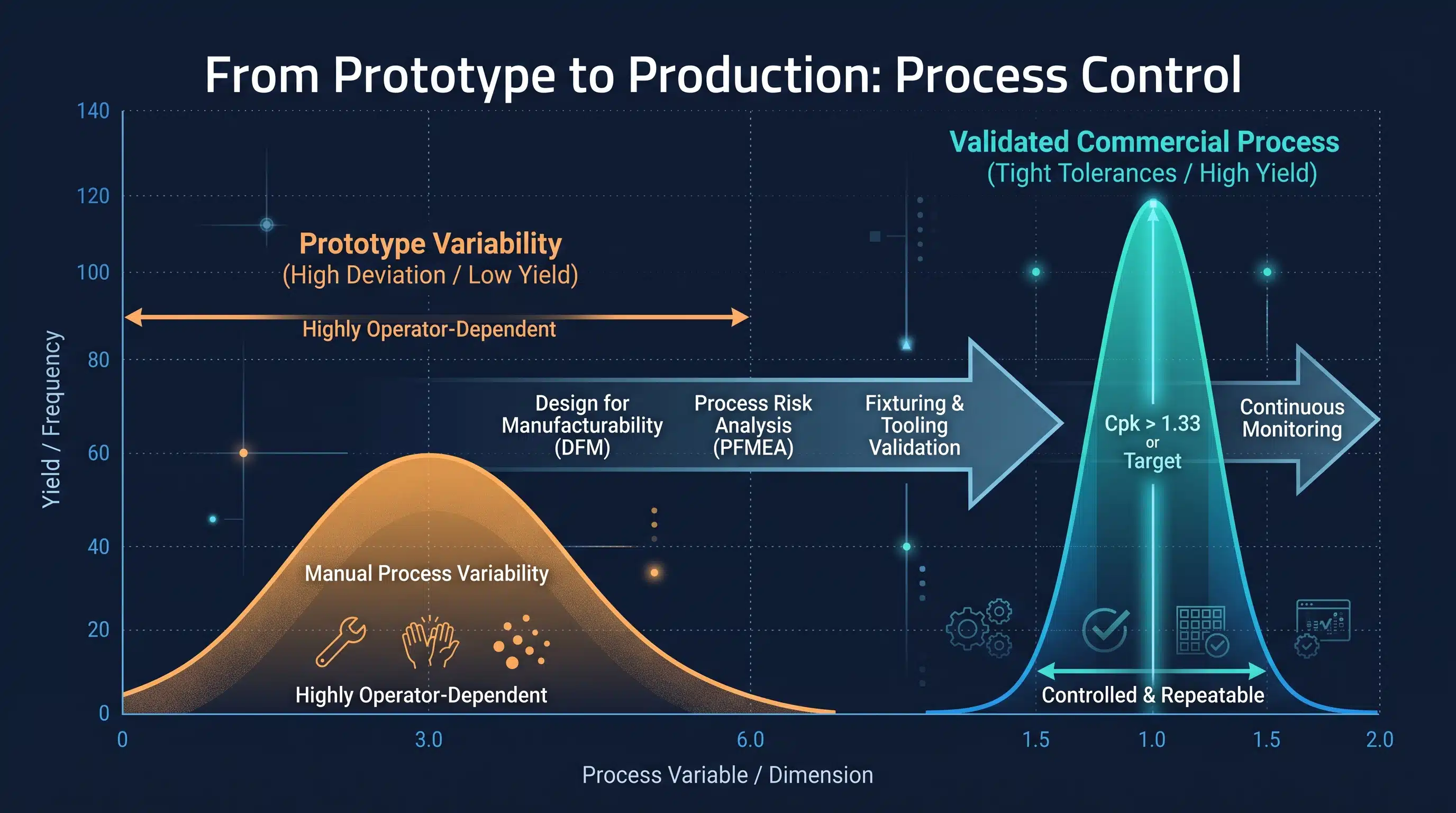
The transition from prototype to production introduces an entirely different set of challenges. Processes that work well when building a handful of devices may become unreliable, inefficient, or too expensive when manufacturing hundreds or thousands of units.
The key to successful commercialization is developing a manufacturing process that consistently produces devices meeting established specifications while maintaining quality, cost, efficiency, and regulatory compliance. And if this is done secondary to the development efforts it can complicate the commercialization path and can lead to redesigns impacting costs, regulatory compliance, and sales.
1. Turning a Device Design into a Repeatable Manufacturing Process
A prototype is often built by highly skilled engineers or technicians who understand the product intimately. They may rely on specialized tools, manual adjustments, or individual expertise to produce a functioning device. Far too often applications of adhesives is a bandage applied rather than changing molds or components allowing simplified processes. Use of ‘off the shelf’ components, while expedient, can often come with unintended defects or yield issues or leave you at the mercy of the vendor’s change control. The result is a manufacturing engineering team who can end up chasing yield losses or non-conformance issues that add significant unaccounted for costs into the cost-of-goods model.
Commercial manufacturing requires a different approach.
The goal is to establish a repeatable process that consistently produces devices meeting predetermined specifications, regardless of which qualified operator performs the work.
This transition typically involves:
One of the most important considerations is understanding the difference between a process that can produce a good device and one that can consistently produce good devices.
A manufacturing process should be developed with repeatability in mind from the beginning of the development process rather than relying on extensive inspection or rework to achieve acceptable results to get to market and ‘re-designing it later’.
Expert Insight: Making Manufacturing Repeatable
Questions for the ZIEN engineering team:
- What are the most common mistakes companies make when moving from a working prototype to a repeatable manufacturing process?
- What practical techniques have you found most effective for eliminating operator-dependent variability?
- Can you share an example where a relatively simple change in tooling, fixtures, or assembly methods significantly improved repeatability?
ZIEN Expert Tip:
CEO Tim Nieman states that use of adhesives should not be the ‘go to’. Far too often it becomes a simple solution to add an adhesive to bond two parts together rather than critically evaluating the bond design and taking that extra component or the adhesive out. Changing the process to be a barb fitting, or solvent bond, or eliminating the bond all together not only cuts out potentially costly adhesives, but can simplify the process and reduces operator or equipment and process variability. Too much adhesive can block lumens, bond geometry can prevent UV curing, UV curing can be inadequate due to poor fixturing or light density, or any number of other potential errors. The right solvent or barb fitting joint can prevent or reduce operator variability and ensure long term performance without the extra material.
Working piece by piece through the design and the assembly process during the development will identify where OTS components can or should be used, where operator or process variability could cause an issue with critical to quality performance requirements, or simply where cost of goods might be improved by simplifying, shortening, or eliminating a step. Labor is the most expensive part of most products, so we always try wherever possible to take labor out of the mix.
Changing a UV cure adhesive process to a solvent bond step has repeatedly gained us both efficiency and quality steps. It has also improved cost and quality. By eliminating a UV cure from a tube bond and swapping to a solvent bond on one device we were able to remove the cost of the adhesive, the cost of the labor, and the time to adhere and cure the bond, and we were able to prevent the potential quality risk of tube occlusion that resulted from the risk of adhesive inadvertently getting to the lumen. It hit all the performance improvements we were hoping for.
2. Designing for Manufacturability
A product can meet every functional requirement and still be difficult or expensive to manufacture.
Design for Manufacturability (DFM) is the practice of evaluating a product design based on how efficiently and reliably it can be produced.
Ideally, DFM begins during product development, before designs are finalized and manufacturing investments are made. The result of not doing so may result in different materials and processes being introduced to reach the cost targets that ultimately in the worst case may create a need for a secondary regulatory filing. Or, if a material is obsoleted a potential risk to supply and sales.
For medical devices, important DFM considerations include component tolerances, material compatibility, assembly sequence, joining methods, inspection accessibility, and the availability of commercially sourced components.
For example, a device may incorporate components with extremely tight dimensional tolerances that are unnecessary for its intended function. These tolerances can increase component costs, reduce manufacturing yields, and complicate assembly. At best case the usual result is non-conformance reports that then requires engineering labor to resolve and disposition the non-conforming component. Spending hours of expensive engineering and quality engineering time to navigate a component through the quality system because it failed to meet a non-critical specification can become an expensive endeavor.
Similarly, a design requiring multiple intricate manual assembly operations may be technically feasible but difficult and expensive to scale.
Effective DFM balances device functionality with practical manufacturing considerations. In many cases, relatively minor design changes can significantly improve production efficiency without compromising device performance. And despite the additional costs that may be incurred for the capital expenses to tool for the DFM the cost savings when the device goes to market can provide a significant return on that investment.
3. Identifying Manufacturing Process Risks Early
Manufacturing risks are often discovered only after production begins, when addressing them becomes significantly more expensive.
A proactive process development strategy identifies potential manufacturing failures before they affect production schedules, product quality, or customer deliveries.
- Inconsistent adhesive application or curing.
- Variation in welding, bonding, or sealing processes.
- Improper component alignment during assembly.
- Material handling damage or contamination.
- Inadequate equipment capability or process control.
- Inspection methods that cannot reliably detect critical defects.
Identifying these risks early, and during the development process allows engineering teams to implement preventive measures through equipment design, process monitoring, operator training, and appropriate verification activities. Controlling these risks throughout the development process helps to ensure a manufacturable and cost-effective product.
The objective is not simply to detect defects. It is to develop manufacturing processes that prevent defects from occurring and improve yields and costs.
Expert Insight: Preventing Manufacturing Problems
Questions for the ZIEN engineering and quality teams:
- Which manufacturing risks are most frequently overlooked during development?
- What process development activities are most effective at identifying risks before production?
- Can you describe a situation where identifying a process risk early prevented a significant manufacturing problem?
ZIEN Expert Tip:
Creating a Master Validation Plan early, and revising it as needed throughout the development process can identify those processes most impactful to the CTQs. By reconciling between the DFMEA and the PFMEA those CTQs may be identified and a process or design improvement can be identified proactively resulting in better controls preventing non-conformances. The natural inclination is for the development team to focus on solving the design problem. By broadening the scope of focus the benefit of focusing on the ‘how you will do it’ is that it can help refine the design for both function and manufacturability.
The discussions around reducing the use of adhesives is a perfect example of the use of the ‘how you will do it’ reflection advising on improving the product and the process. The net result of that is very often the most economical and most robust design and manufacturing processes.
4. Selecting Equipment and Developing Assembly Methods
Selecting the appropriate manufacturing equipment is a critical part of process development.
The most sophisticated or highly automated equipment is not always the best solution. Equipment selection should be based on production volumes, process requirements, quality expectations, capital investment, and anticipated future growth. Considerations at the beginning of a manufacturing process can include decisions between prototype/low volume molds vs multicavity production tools, 3D printed or machined fixtures, UV cure stations vs conveyor cure stations, and other equipment decisions needed to meet the first 1-3 years of forecast. Sometimes setting up a second line or a second shift is infinitely more appropriate than scaling for automation.
For many medical devices, a well-designed manual or semi-automated assembly process may offer greater flexibility and lower initial costs than full automation. Especially for startup companies, the investment in high volume automation is rarely a good investment before the product volumes reach those needs. This drives the need for a well designed and robust process and fixtures capable of meeting initial volume demands while the market is developed. This also allows for any minor design modifications to be implemented prior to the investment in automation. For example, should a component dimension or tolerance need to be changed for yield or performance needs, this can be done with fixtures tooling changes where the potential to impact expensive automation equipment is mitigated.
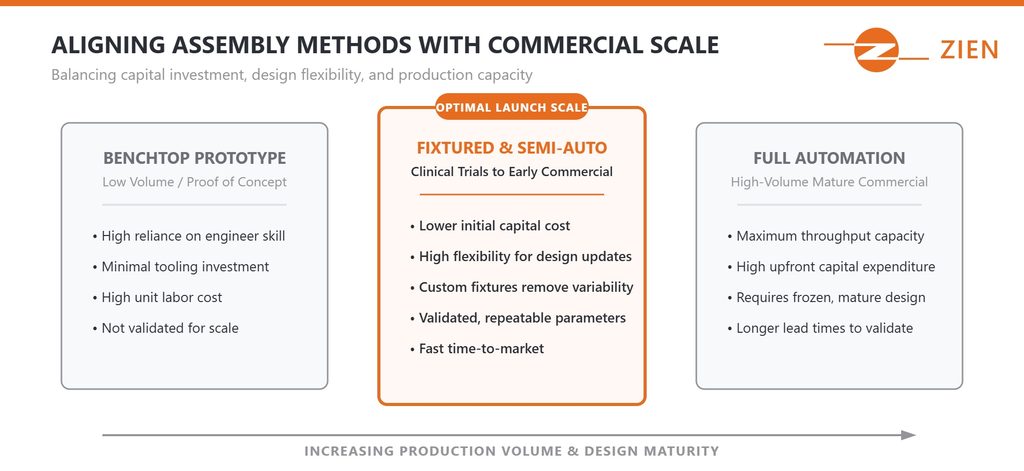
Key considerations when developing manufacturing equipment and assembly methods include:
- Process capability: Can the equipment consistently achieve the required product specifications?
- Production capacity: Can it support anticipated manufacturing volumes?
- Flexibility: Can it accommodate product variations or future design changes?
- Operator interaction: How much does the process depend on manual skill or judgment?
- Maintenance and reliability: Can the equipment be maintained and supported throughout the product lifecycle?
- Validation requirements: Can critical process parameters be controlled, monitored, and documented?
Expert Insight: Choosing the Right Manufacturing Solution
Questions for the ZIEN manufacturing engineering team:
- How do you determine when manual assembly is appropriate versus when automation is justified?
- What factors should companies evaluate before investing in custom manufacturing equipment?
- Can you provide an example where a simple fixture or semi-automated process proved more effective than a more complex solution?
ZIEN Expert Tip:
How to meet the forecast comes with a wide range of inputs to consider. This includes manufacturing space, personnel, estimated production time per unit, capital expense requirements, and various others. There is no right answer in all cases. Scaleup can be done in phases or all at once depending on the confidence in the forecast and what working capital is available. Almost more important however are potential design changes, or how confident the team is about the design being completely stable. The answer to these questions may drive how much expenditure is warranted. Balancing these various factors should be a strategic decision made by Sales, Operations, Finance, and Management to make sure the short, and the long term strategies are aligned.
How ZIEN Medical Technologies Can Help
At ZIEN Medical Technologies, we understand that bringing a medical device to market involves much more than developing a functional product.
Our integrated engineering, process development, manufacturing, and quality system capabilities help medical device companies navigate the transition from prototype development through commercial production. Through a review of the DFMEA and PFMEA ZIEN’s team can help achieve the best cost, quality, and volume capabilities for production. We also view simplification of the design and processes critical for the long term stability and quality of the product while also understanding business objectives may result in balancing the process approach to reach the best convergence of time, cost, and reproducibility. By addressing manufacturing challenges early and developing processes designed for long-term consistency, we help our customers establish a foundation for successful commercialization.
Ready to move your medical device from prototype to production?
Connect with ZIEN Medical Technologies to discuss how our process development and manufacturing capabilities can support your product’s path to commercialization.